Peak District National Park
75th Anniversary
On April 17th 1951, the Peak District was designated the UK's first National Park. Its central location between the industrial cities of Manchester and Sheffield highlighted the urgent need for recreational space for urban populations, balancing conservation with public access. More than seven decades on, that same landscape of sweeping moorland, limestone dales and ancient villages continues to offer a beautiful place to escape and explore.
During the month of April, there is a special programme of guided walks led by the Peak District Rangers. Find out more using the link below...
Britain's first National Park
The Peak District
The Peak District holds the proud title of Britain's very first national park, officially designated back in April 1951. Spanning around 555 square miles — roughly the same footprint as Greater London — it sits at the geographical heart of England, stretching across five counties: Derbyshire, Cheshire, Staffordshire, Yorkshire and Greater Manchester.
Its location makes it uniquely accessible, sitting within easy reach of major cities like Manchester, Sheffield, Nottingham and Derby.
The landscape itself falls into three distinct characters. The Dark Peak is defined by dramatic gritstone edges and sweeping moorland; the White Peak by its steep, winding limestone dales; and the South West Peak by gentler rolling hills and farmland. The highest point, Kinder Scout, rises to just over 2,000 feet. Winding across it all are an extraordinary 26,000 miles of dry stone wall — enough to circle the entire Earth.
Unlike many national parks around the world, which exist as untouched wilderness, the Peak District is very much a living, working landscape — home to around 38,000 residents.
Exploring the Peaks
There's no shortage of ways to enjoy the Peak District. Visitors come for walking, cycling, climbing, caving, mountain biking, wildlife watching, photography, and simply soaking up the atmosphere in traditional country pubs and tearooms.
Walkers are particularly well served. The famous Pennine Way — Britain's oldest long-distance trail — sets off from the village of Edale and winds 268 miles all the way to the Scottish border. The park also contains 202 square miles of open access land, meaning walkers can roam freely without being confined to marked paths, supported by 1,600 miles of public rights of way. On top of that, the National Park Authority maintains 34 miles of traffic-free trails, many following the routes of old railway lines ~ one of which, The Tissington Trail, is located 5 minutes from Wildhive Callow Hall and guests can use the hotel bikes to explore.
History and Heritage
The Peak District's story stretches back millions of years, when the area lay beneath a tropical lagoon — fossils of ancient sea creatures can still be found today, even at altitude. Farming began here around 6,000 years ago, and traces of Roman-era field systems are still visible in the landscape.
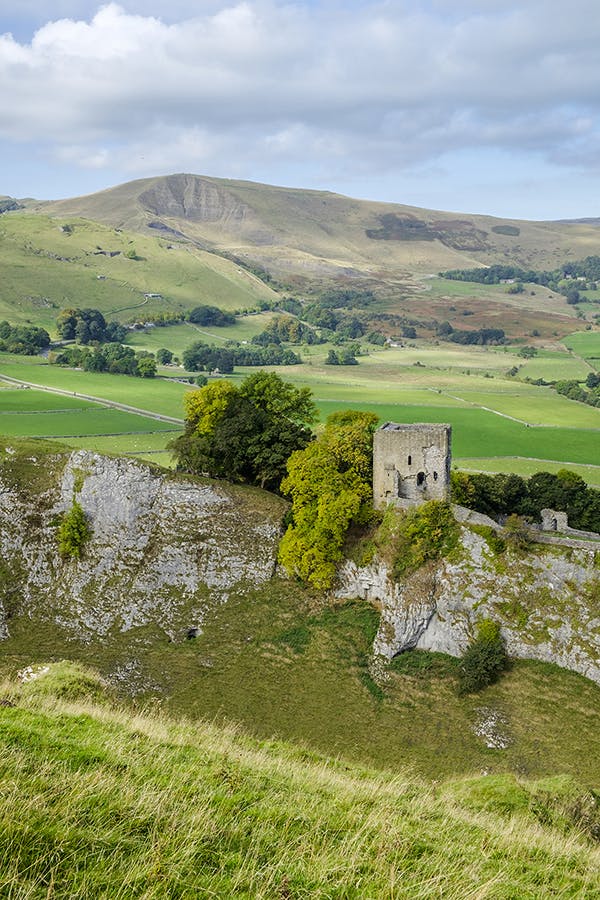
The name 'Peak' has nothing to do with the hills — it's thought to come from the Pecsaetan, an Anglo-Saxon tribe who once settled here. There are curious historical footnotes too: the lead used in the white paint of Vermeer's famous Girl with a Pearl Earring was mined in the Peak District, and one of England's earliest Norman fortresses, Peveril Castle, still stands at Castleton.
Wildlife & Conservation
The Peak District supports a remarkably varied range of wildlife across its different habitats. The limestone dales of the White Peak are rich in wildflowers and orchids, while the Dark Peak's peat bogs are internationally significant for their rare birds and plant life.
Notable species include mountain hares — found nowhere else in England outside the Scottish Highlands — along with red deer, water voles, ring ouzels and several birds of prey including peregrine falcons, goshawks and merlins. The peat bogs are also home to unusual plants like the round-leaved sundew among vast carpets of sphagnum moss.
Three-quarters of the world's heather moorland is found in the UK, with a significant portion lying within the Peak District. The park's blanket peat bogs are among the most ecologically valuable habitats on the planet, storing vast amounts of carbon in a way that rivals the effectiveness of tropical rainforest.
The Millstone Symbol
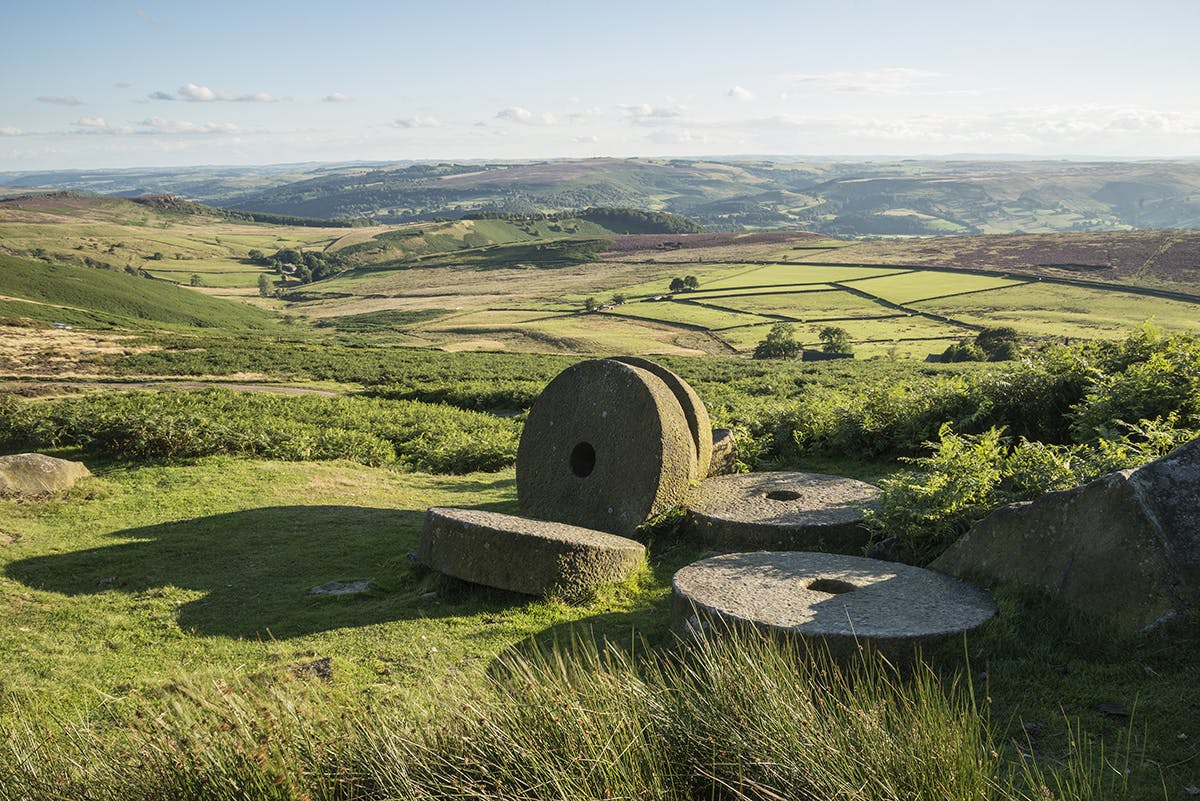
The millstone is the emblem of the Peak District, appearing on boundary markers and in the park's official logo. These distinctive stones have a long history in the area — corn mills were already recorded in the Domesday Book in 1068, and gritstone quarrying dates back to at least the 12th century, with some evidence pointing even further to Roman times.
For centuries, millstones from the Peak District were put to work grinding grain, sharpening tools in industrial cities like Sheffield, and even processing timber as far afield as Scandinavia. At Millstone Edge near Hathersage, visitors can still see discarded stones left behind when cheaper imports made local production unviable.
Literature & Film
The Peak District has long captured the imagination of writers and filmmakers. Jane Austen set much of Pride and Prejudice in and around Bakewell, with Chatsworth House serving as her vision of Mr Darcy's Pemberley. Charlotte Brontë stayed at North Lees Hall near Hathersage, and the house later inspired Thornfield Hall in Jane Eyre.
Wordsworth, Conan Doyle and many others have drawn inspiration from the landscape, and it continues to provide the backdrop for crime novelist Stephen Booth's popular series. On screen, the 1995 BBC adaptation of Pride and Prejudicewas filmed here, as was the 2005 feature film starring Keira Knightley.
In a remarkable wartime chapter, RAF 617 Squadron — the legendary Dambusters — trained over Derwent and Howden reservoirs before their famous raid on the Ruhr Valley dams in 1943.
Traditions and Folklore
Two ancient customs keep the Peak District's cultural heritage very much alive. Well dressing — the art of decorating village wells with intricate pictures made from petals, seeds and berries — has been practised here since at least 1349, with over 70 villages still taking part today. You can experience this in the village of Tissington, close to Wildhive Callow Hall.
Each May, the village of Castleton celebrates Garland Day, a colourful procession in which a Garland King and Queen ride through the streets on horseback, with a magnificent floral garland eventually hoisted to the top of the church tower — a tradition believed to mark the restoration of King Charles II.